Director's Note
Translating Commons
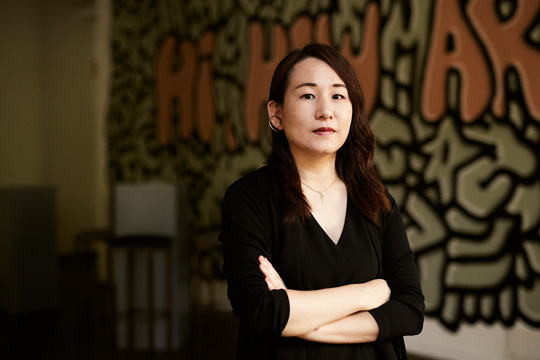
Chiaki Soma
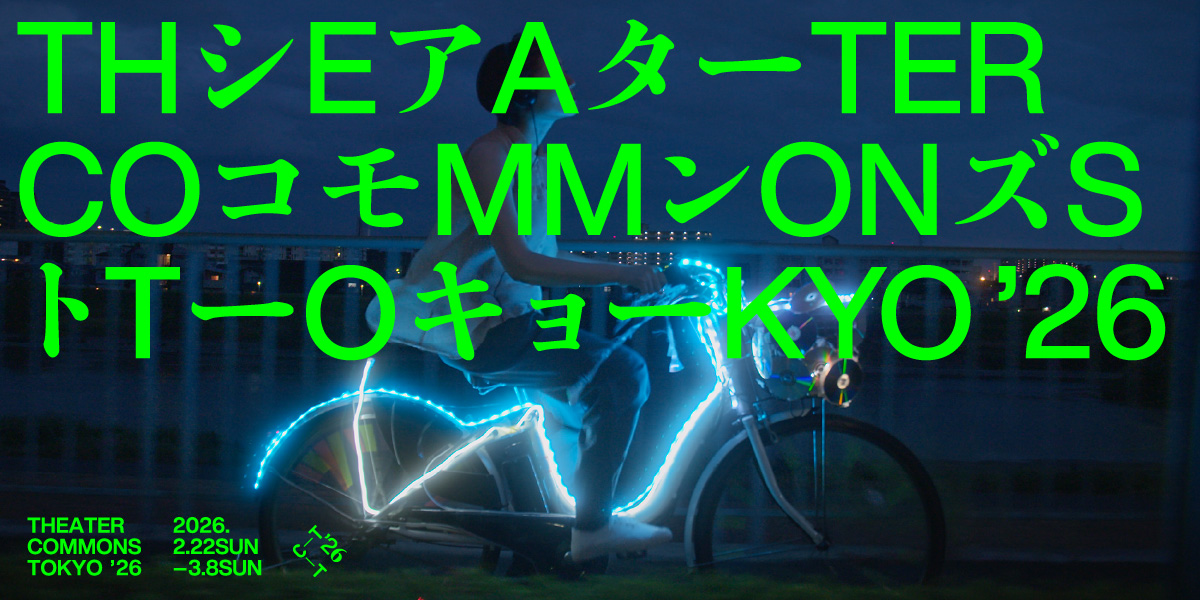
Theater Commons Tokyo is a new project that expands on the concepts of theater as both a space and a medium. Harnessing theatrical ideas within everyday life and the city, it aspires to propose an ideal future theater.
2The first edition of Theater Commons Tokyo was launched on January 25th, 2017 with this statement. By utilizing the accumulated, historical common knowledge (commons) of theater as a medium, each year we have attempted to create a temporary commons within our lived society. From our founding to the present, this understanding has always stood as our aim and raison d’etre as an independent project.
In exchange for the precarity of not having a fixed theater or stage, the various works and projects created and presented at Theater Commons Tokyo have germinated from a place free of spatial limitations. I believe that we have developed unique viewing experiences and participatory formats by repeatedly embarking on inevitable artistic challenges, no matter how small the scale. For example, we have presented reading performances in which audience members participate in the work by reading a play aloud for the first time; XR and Metaverse pieces created in a concentrated period out of the need to experience them in small or remote groups due to the coronavirus pandemic; therapy performances that use acupuncture and yoga to incorporate the physical effects triggered in audience members’ bodies; and works that reenact specific historical events through temporarily formed groups.
These performances over the past decade demonstrate how the essence of theater that Theater Commons Tokyo pursues lies in the experiences of its audience members. Although some of the works were later expanded and presented at large-scale art festivals such as Aichi Triennale 2019 and Aichi Triennale 2022, where I served as one of the curators, and Theater der Welt 2023, for which I worked as program director, I would like to emphasize that all of these experiments started here at Theater Commons Tokyo.
Marking this special 10th edition of Theater Commons Tokyo, we are inviting Art Translators Collective (ATC) as our collaborative partner, a group of translators that have never been credited as “participating artists,” despite being the only ones to have worked with us every year. The members of ATC have translated all of our curatorial concepts and program descriptions, and interpreted for countless talks and workshops. When I look back on this decade, it is not an overstatement to say that they are the ones who have embodied the ethos behind Theater Commons Tokyo: to utilize the common space (commons) of theater to create common knowledge (commons) for society.
For example, the opening performance for the inaugural edition of our festival was watching the city / writing the real, a workshop by French director Pascal Rambert, and it was ATC’s associate member Akihito Hirano who interpreted for this three-day program that was scriptless and entirely improvised. Just as “interprète,” the French word for interpreter, also signifies a performing artist, Hirano has established a unique style of interpreting that blends assimilating to and dissimilating from the speaker, embodying the two roles of interpreter/performer. In addition, ATC’s founding members Kanoko Tamura and Tomoko Momiyama have translated and incarnated an astonishing amount of theatrical knowledge shared by artists invited from around the world, deepening their inquiries as mediators/artists and applying their expertise to their respective creative practices.
The ominous theme proposed by these closest of collaborators—The Death of Translation—not only stems from a despairing sense that their own market value will be nullified with the rise of AI. It is based on a deep concern that “the end of translation” may potentially lead to “the end of creative activity” in the near future. The act of translation involves more than mere conversion of language: it transposes one reality to another. For example, to “translate” the world perceived by a certain human into a different medium such as painting, music, language, or physical expression defines the creative activities that we have engaged in since childhood and since humankind’s very beginnings. However, through computational calculation, AI generates such creative translations in an instant. In an age where AI’s ability to mimic humans and increase its learning speed renders AI-generated material increasingly difficult to distinguish from human creations, what happens to the joys, pleasures, and spontaneity of our creative activities?
Even if “humanness” attests to undefined elements that are difficult to convert to data—such as slippages, mistakes, and hesitations—how do we prove that we are human or that something is created by us in a near future in which AI may learn to deftly generate such mimicry? When such a time arrives, can the common knowledge (commons) long accumulated through theater prove to be of use? For this year’s Theater Commons Tokyo, we apply the urgent question posed by ATC—“Is this the death of human translation (creative activities)?”—to our overall program, opening up discussion around our impending future surrounding the theater commons (knowledge/space), in which contending with AI becomes unavoidable.
For our opening program, we will host a screening and talk for Satoko Ichihara’s play The Bacchae−Holstein Milk Cows, newly directed for the Schauspielhaus Zürich. In the process of translating the play from Japanese to German, how was the distinct context of Japan in 2019 translated to that of Zurich in 2025? If the act of directing itself is a process of translating the specificity of a certain age or society into another, how did the creators overcome the slippages that occur in the process of directing/translating, enjoy its logical leaps, and share the context with the local audience? Joined by the chief dramaturg from the Schauspielhaus Zürich, we kick off Theater Commons Tokyo with the ancient yet new question of the role of translation within theater.
The following weekend, we present Shuntaro Matsubara’s latest play Beautiful Ridiculous Scenario of the Sorcerer’s Apprentices, directed by Ayaka Ono Akira Nakazawa Spacenotblank. Matsubara’s works can be seen as flouting the impossibility of their own translation in his exploration of playful deviations by intentionally inserting glitches and slippages into modern language and logical thinking. The two artists of Spacenotblank confront this impossibility with their majestic directing skills. The combination of Matsubara’s play and the duo’s direction creates random numbers that the actors’ bodies and expressions generatively translate into the theater space. This, in turn, sparks confusion and pleasure within the audience members’ minds, perhaps leading us to recognize an unwithering “humanness” within the AI era.
Anne-Sophie Turion and Eric Minh Cuong Castaing’s HIKU solely consists of Japanese-French interpreters/performers. The three cast members, who have experienced severe levels of social withdrawal (“hikikomori”) and are currently reintegrating into society, perform from their rooms using remotely-controlled robot avatars. As they withdraw themselves (“hiki”) from embodied, forceful in-person communication and translate conversation along different pathways to transform the theater space into an intimate commons, we may see one future of the theater as a place where anyone can freely sit on the floor and relax in whatever way they like.
Artist Yuki Harada has been utilizing computer graphics and synthetic voice to create landscapes, faces, and voices that appear familiar or specific but are, in fact, non-existent. While unsettling the viewer’s perceptions and subconscious, he has consistently grappled with universal questions within contemporary art by responding to the history of the arts. For his first work at Theater Commons Tokyo, he collaborates with choreographer Saori Hala and references Francisco Goya’s words and painting The Sleep of Reason Produces Monsters to adapt his antitheatrical settings—as seen in past works such as Light Court and Waiting for—into the existing space of SHIBAURA HOUSE. What processes of translation and complicity will occur between the audience members and the performers commissioned to engage in these acts?
The various programs presented by ATC throughout the festival open up large-scale inquiries into the creativity of humankind by confronting the possibility of the end of translation. Interpreter Kanoko Tamura and artist Mayunkiki together face the realities surrounding translation as both speaker and interpreter to reframe it as a bridge to changing society, and present a lecture performance that culminates in a manifestation for the future from dominant and marginalized positions. The aforementioned Akihito Hirano welcomes Chiharu Shinoda as director to stage a solo show in which he himself translates his own poetic treatise, This is Not the End of Human Translation.
Interpreter and composer Tomoko Momiyama, who has spent many years critically exploring the ethics and aesthetics of listening, collaborates with sign-language musician and poet Sasa-Marie to create a ritual that shares the pleasures of interpretive listening as a queer and feminist practice that transcends the physical sense of hearing. Video artist and translator Lillian Canright presents a live video essay-cum-lecture performance, while interpreter, playwright, and actor Haruka Ueda performs a self-interpreted, Japanese-English one-person show without subtitles. All of the interpreters/artists sublimate their multiplicitous identities into singular narratives.
In addition, to mark our ten-year anniversary, we present Commons Camp 2026 for Next-generation Curators, a special program in which curatorial ideas and practices are shared with the coming generation. Curation is creative work that mediates between artworks and audience members by interchangeably translating different periods, histories, societies, contexts, and the languages and cultures that serve as their bases. This program aims to create a temporary community in which participants learn together about the possibilities of curation within the Asian region, by externalizing and verbalizing the practical knowledge surrounding curators as translators/mediators. By posting these lectures and presentations online, we hope to create a video archive that remains open and accessible as a public resource in the future.
With it becoming increasingly difficult to distinguish information generated by humans and AI, how do we prove our humanity to a suspicious other? When the origins of literature, art, and even music become dubious, perhaps live performance conducted in front of actual people may become the ultimate luxury. Will the theater space, then, accrue value as a place for humans to prove their humanity? Will the act of humans performing in front of each other, or the undatafiable atmosphere and magnetic field that thereby occurs, be considered the future commons? As we sense these tenuous possibilities, Theater Commons Tokyo raises its curtain toward another decade. We invite you to join us in experiencing this embodied feeling.
Chiaki Soma
Representative Director of NPO Art Commons Tokyo, art producer. Program Director of the Opening Preparation Department, Minato Arts Center. Associate Professor at the Graduate School of Global Arts, Tokyo University of the Arts. Specializes in curating and producing work that crosses the interdisciplinary boundaries of contemporary art. The main art festivals she has served as program director or curator include "Festival/Tokyo" (2009–2013), "Aichi Triennale 2019" and "Aichi Triennale 2022", "Theater Commons Tokyo" (also serving as executive committee chair, 2017–present), and "Theater der Welt 2023" (Germany). In 2015, she was awarded the French Order of Arts and Letters Chevalier, and in 2021 she was awarded the Art Encouragement Prize of the Ministry of Education, Culture, Sports, Science and Technology.